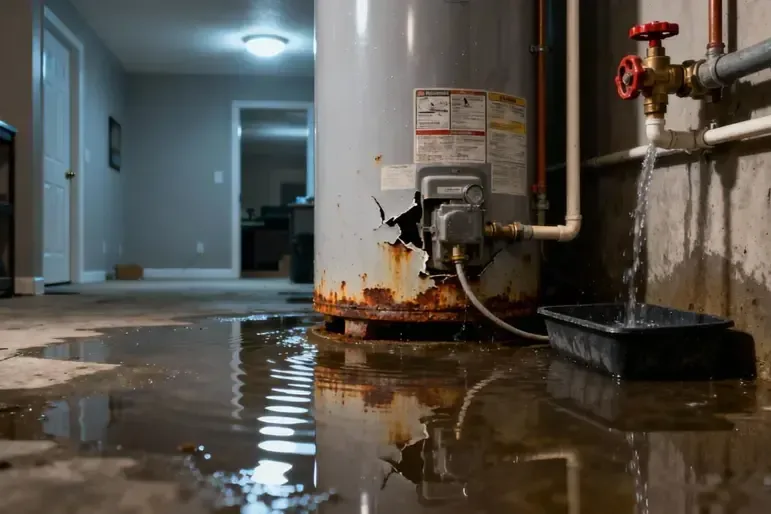
A tank water heater holds enough water to soak a closet or garage floor quickly when it fails. In Marana, where the town's water quality report lists hard water, the tank deserves a look.
Key takeaways
- The town's water quality report, in its October 2024 table, lists hardness of 10 to 18 grains per gallon in the main system, with an average of 14.
- Mineral scale and sediment build up inside a tank and add wear over time.
- A tank that leaks from the shell is replaced, not patched, and the cleanup is a separate job from the replacement.
- Where the tank sits, in a garage, closet or attic, decides how far the water travels.
- Extraction and drying remove the water, and wet drywall, insulation and cabinet bases are checked.
What the water quality report shows about hardness
The town publishes a water quality report, and its October 2024 table lists hardness by area. Hardness is measured in grains per gallon.
The report is the town's own, so the current version has the latest numbers. A homeowner who knows the local grains per gallon can talk about water quality with a plumber more precisely.
- The main system runs 10 to 18 grains per gallon, with an average of 14. It covers Gladden Farms, Rancho Marana, Honea Heights, Yoem Pueblo, Marana Main Street and the Tangerine area.
- Picture Rocks, Continental Reserve and Cortaro-Silverbell are about 13.
- Twin Peaks is about 12.
How scale and sediment wear on a tank
Numbers in that range mean mineral-heavy water. As it heats, minerals settle out, coat the heating parts and collect as sediment on the tank floor.
Sediment makes the tank work harder. Over the years the steel can corrode, a seam can open and the tank can start to seep.
Some homeowners add a softener to deal with scale. That is another appliance with a drain and a brine tank, and it can leak too.
A water heater leak cleanup usually begins after one of these warning signs was missed.
- Rumbling or popping while the water heats.
- Rust-colored water or rust stains at the base of the tank.
- A relief valve that weeps or drips.
- A damp spot, warped flooring or a musty smell beside the tank.
- A tank that is simply old. Age raises the odds of a sudden failure.
Where the tank sits changes where the water goes
Whatever the location, water follows gravity and framing. It goes down first, then out along the lowest path it can find.
Garage tanks
Water on a garage slab runs toward walls, stored boxes and any door into the house. The goal is to get it out before it reaches drywall.
Closet and utility room tanks
Water goes under the tank base into wall framing, drywall and the floor beside it. A closet next to a hallway or bedroom sends water into carpet and wall bottoms.
Attic tanks
A tank above living space drops water through the ceiling. Wet insulation gets heavy, the drywall sags, and the leak can spread across a wide area before a stain shows.
First steps when a tank starts leaking
Shutting off the supply stops new water but does nothing for what is already on the floor. Water extraction does not need to wait for the plumber.
- Turn off the cold water supply to the tank.
- Switch off the power or gas to the heater.
- Keep out of the water if outlets or cords are wet.
- Photograph the tank, the floor and anything damaged.
- Move boxes, rugs and furniture out of the wet area.
- Ask a plumber to handle the tank and a restoration team to handle the water.
The plumber's part
The plumber confirms why the tank leaked, shuts off and drains it, and installs the replacement. Any permit or code step belongs to that job.
The restoration team's part
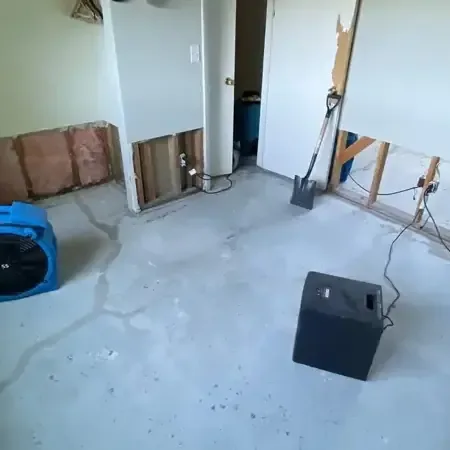
The restoration team handles the water: extraction, moisture mapping, removal of wet materials and drying. The two jobs can run side by side.
What extraction and drying take care of
The extraction crew removes the standing water first, then checks walls, floors and cabinets with a moisture meter.
Monitored structural drying finishes the job once the surface water is gone.
- Drywall that wicked water above the baseboards is cut and replaced.
- Wet insulation behind or under the tank is removed.
- Vinyl and laminate flooring is often lifted so the subfloor can dry.
- Toe kicks are pulled so air can reach the cabinet cavity.
- Dehumidifiers and air movers run until the readings match a dry reference.
How far the water travels inside the walls
Water that reaches a baseboard does not stop there. Drywall wicks it upward, and the cavity behind the wall holds it against the framing.
That hidden water is why a floor that looks dry on the surface can still be wet underneath. The moisture meter shows what the eye cannot.
- Baseboards and the bottom of the drywall take water first.
- Cabinet bases and toe kicks trap water in a closed cavity.
- Subfloor under vinyl or laminate holds moisture long after the surface is dry.
- Insulation inside wall cavities clumps and stays wet.
Preparing for an aging tank
A tank near the end of its life is easier to replace on a schedule than to clean up after a failure. Flushing sediment is a common maintenance step, and a plumber can judge whether a tank is worth keeping.
Stored items on a garage or closet floor near the tank make a slow leak harder to spot and a fast leak more costly.
A drain pan under the tank catches small drips but cannot hold a full tank failure. The water damage cost calculator helps homeowners see typical ranges before a loss happens.
- Write the tank's install date on the tank itself.
- Look at the base of the tank each month.
- Keep the area around the tank clear of boxes and cloth.
- Find the cold water shutoff and test that it turns.
Questions
Does hard water cause a water heater to leak?
Hard water does not make a tank leak by itself, but mineral scale and sediment add wear over time. An old tank in hard water is more likely to fail.
How hard is the water in Marana?
The town's October 2024 water quality table lists the main system at 10 to 18 grains per gallon, with an average of 14. Picture Rocks, Continental Reserve and Cortaro-Silverbell are about 13, and Twin Peaks is about 12.
Can a leaking water heater be repaired?
A tank that leaks from the shell or a seam is replaced. A leak at a valve or fitting may be fixable, and a plumber can tell which.
Is a water heater leak covered by insurance?
It depends on the policy and the cause. Sudden tank failure is often treated differently from a slow leak. Reading the policy wording or asking the insurer gives a clear answer.
What if the tank is in the attic?
Water drops through the ceiling, so the drywall and insulation below are checked first. The ceiling may need to be opened to dry the space above it.
How can a homeowner tell a tank is near the end of its life?
Rust stains at the base, a dripping relief valve, rumbling during heating and an older tank are common signs. A plumber can assess the tank and advise on timing.