Structural Drying and Dehumidification in Marana, AZ
Surfaces feel dry long before framing, slab and wall cavities are. The drying team sizes air movers and dehumidifiers to the class of loss and keeps them running until readings match a dry reference.
(888) 949-8496Floor feels dry but smells damp? Get readings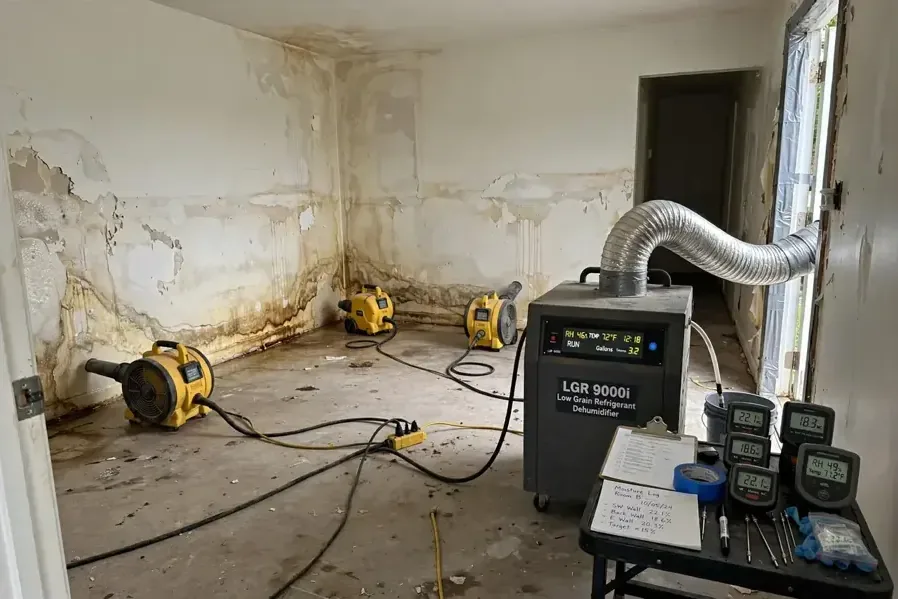
What every structural drying and dehumidification job includes
24/7 dispatch
Active water is treated as urgent at any hour, and the nearest crew rolls with pumps, air movers and meters.
IICRC S500 drying
Truck-mounted extraction, LGR dehumidifiers and air movers, run to a measured dry standard instead of a guess.
Claim-ready records
Moisture maps, daily psychrometric logs and timestamped photos taken before any demolition.
Desert-home experience
Slab floors, attic air handlers, hard water and monsoon runoff shape every drying plan here.
What to do right now for structural drying and dehumidification
- Keep it closed. Shut exterior doors and windows so the drying space stays controlled.
- Run the AC. Cooling helps pull humidity out until equipment arrives.
- Skip the box fans. They spread dirty water and do not dry wall cavities.
- Note what is wet. Point out every room, closet and cabinet that got water.
What does structural drying and dehumidification cost in Marana, AZ?
In Marana, AZ, structural drying typically runs $1,500 to $10,000, depending on the class of loss, the number of rooms, whether concrete or hardwood needs desiccant drying and how many days the equipment runs.
Class 1 or 2, one area
- Air movers
- LGR dehumidifier
- Daily readings
Class 3, several rooms
- Containment
- Wall cavity drying
- Psychrometric logs
Class 4, slab or hardwood
- Desiccant drying
- Floor drying mats
- Extended monitoring
Documentation for the insurance claim
The claim file holds a moisture map, daily psychrometric logs, timestamped photos taken before demolition, the water category and class of loss, and a line-item scope. Sudden and accidental water is often covered, while rising flood water usually needs a separate flood policy. Coverage depends on your policy, so check with your own insurer.
Ranges are typical, not a quote: water category, square footage, material class and how fast drying started move the number most. Run the water damage cost calculator for a closer range.
How structural drying and dehumidification is handled, step by step
Map
Moisture map of every wet material.
Set
Air movers and dehumidifiers sized to the class.
Monitor
Daily psychrometric and material readings.
Close out
Equipment leaves when readings match dry.
Structural drying is the part of a water loss that decides whether the job holds up. Desert air outside is dry, but a closed house with wet drywall, slab and cabinets is not, and evaporation stalls without equipment. The drying team builds a drying plan around the class of loss and proves the result with numbers.
How the plan is set
- Class 1: little water, mostly low-porosity materials
- Class 2: a whole room, carpet and wall bottoms wet
- Class 3: water from above, walls soaked high
- Class 4: dense materials like concrete and hardwood
The class sets how many air movers and how much dehumidifier capacity each room needs.
Equipment and containment
Air movers sweep air across wet surfaces to speed evaporation. LGR dehumidifiers pull that moisture out of the air, and desiccant units take over when concrete or hardwood is slow to release water. Plastic containment shrinks the space being dried so the equipment works on the wet area, not the whole house.
Readings decide when it is done
Psychrometric readings of temperature, relative humidity and grains per pound are logged daily, along with material readings in fixed spots. Equipment stays until materials sit within 2 to 4 points of a dry reference in the same house. The EPA indoor air quality pages explain why lingering moisture matters, and the University of Arizona Cooperative Extension publishes home care information for Arizona households.
Structural drying and dehumidification across Marana and northwest Pima County
Marana Water Damage Restoration covers ZIP 85653 and 85658, from Continental Ranch and Cortaro near the interstate out to Gladden Farms, Saguaro Bloom, Twin Peaks and the Dove Mountain communities below the Tortolita Mountains.
Nearby coverage reaches Oro Valley, Tucson, South Tucson, Picture Rocks, Rillito.
Related water damage services
Structural Drying and Dehumidification questions, answered
Still dealing with it?
Need the structure dried to numbers? The drying team sets up 24/7.
(888) 949-8496 Log the daily dry readingsWhy can't the equipment come out when the floor feels dry?
Framing, slab and drywall hold water after surfaces feel dry. Readings decide, so equipment stays until materials match the dry reference.
Does dry desert air make drying faster?
Outdoor air is dry, but a closed, wet house is not. Dehumidifiers control the indoor air so evaporation keeps going.
What is a dry reference?
A reading taken on the same material in an unaffected part of the house. Wet materials are dried to within 2 to 4 points of it.
Why is concrete so slow to dry?
Concrete is dense and releases water slowly, so slab drying often needs desiccant dehumidifiers and more days.
Can I stay home during structural drying?
Usually yes. The equipment is loud and runs around the clock, but containment keeps it to the affected rooms.
What is psychrometry?
The measurement of temperature, humidity and moisture in the air. Daily psychrometric logs show the drying is working.
Walls and floors still wet? Get them dried to a real standard.
Wet framing and slab dry slowly in a closed house. The drying team sizes the equipment and proves the result with readings.
(888) 949-8496Book a structural dry-out