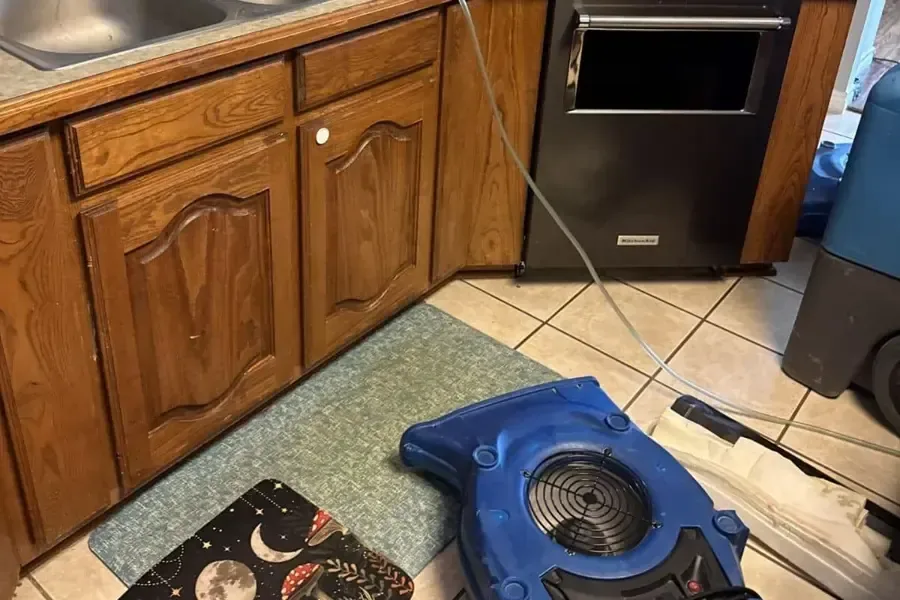
Many Oro Valley residents keep a second or winter home in town. When nobody lives in a house for stretches of the year, a small leak has all the time it needs.
Key takeaways
- The 2020 Census counted 23,303 housing units in Oro Valley, and 10.8 percent were vacant.
- A leak in an empty house can run for days or weeks before anyone sees it.
- Washer hoses, water heater tanks and ice maker supplies are common sources.
- Closing the main water valve before leaving is the simplest protection.
- Extraction and drying focus on cabinets, subfloor and the bottoms of walls, where water settles.
Why an empty house hides a leak
At the 2020 Census the town had 23,303 housing units, and 10.8 percent of them were vacant. Many residents also keep a second or winter home here, so some houses sit quiet for long stretches.
A lived-in house shows a leak fast: a wet spot, a sound, a bill that jumps. An empty house has no one to notice, so water keeps running until the supply is shut off.
Both kinds of quiet house share the same risk, since no one is there to notice a drip. A leak that would be a small annoyance in an occupied home becomes a flooded floor.
The quiet is what turns a small failure into a large loss.
Where the water comes from
Pressure is constant. A supply hose or tube holds back the full pressure of the plumbing day and night, so a weak spot can give way without warning.
- Washer and dishwasher hoses.
- Ice maker and refrigerator supply tubes.
- Toilet supply connections.
- The water heater tank and its fittings.
- Air conditioner condensate drains.
Hoses and supply pipes
Washer hoses, dishwasher connections, ice maker supplies and toilet supplies are small parts under constant pressure. When one splits, it can empty into a cabinet or onto a floor.
Water heater tanks
A failing tank can release a full load of water and soak flooring and drywall. In an empty house nobody sees the puddle until the damage is deep.
Air conditioner drains
Condensate drains can clog and overflow into ceilings and walls if the system still runs while the house is empty.
Preparing the house before leaving
A short routine before leaving costs little compared with a flooded kitchen. A shutoff valve only helps if it is actually closed.
Valve and tank settings differ by home, so a plumber or the owner's manual gives the right steps for each appliance.
Leak sensors and automatic shutoff valves add another layer, since a shutoff valve can stop a leak when no one is there.
- Turn off the main water valve.
- Turn the water heater down or off.
- Replace old rubber hoses with braided hoses.
- Ask a neighbor or caretaker to walk through the house on a regular schedule.
- Consider leak sensors that send an alert to the owner.
- Leave a contact list with the caretaker.
- Close the outdoor hose valves.
What a long unseen leak does
Water that runs for days moves out from the source. It wicks up drywall, soaks cabinet bases and the subfloor, and runs under flooring.
A long period of wetness is also when mold can start, which is why drying cannot wait until the owner returns.
Under flooring, a thin film of water spreads far. Vinyl, laminate and wood can hide a wide wet area until a board lifts.
- Swollen or warped flooring.
- Peeling paint and soft drywall.
- Stained cabinet bases.
- A musty smell when the door is first opened.
- Warm, damp air in a closed house.
What extraction and drying involve
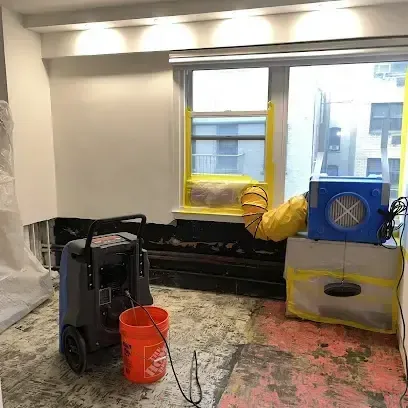
The first job is to remove standing water with water extraction equipment. After that the team checks every connected space with a moisture meter.
Appliance leak cleanup then covers pulling toe kicks, opening wall bottoms where readings are high, and drying cabinets and the floor.
Dry materials can sometimes be saved. Solid wood, tile and sealed stone often survive when the water is removed early, while pressed wood and soaked insulation usually do not.
- Standing water is pumped or vacuumed out.
- Wet drywall and insulation are cut out.
- Cabinets are opened so air can reach the cavity.
- Dehumidifiers run until readings match a dry reference.
- Moisture readings are repeated on every visit.
When the owner is out of town
An owner who lives somewhere else can still arrange the response. A caretaker with a key can let the restoration team in, and the owner can approve the work by message.
Photos taken before and during cleanup give the owner a record of what was found. More about local help is on the Oro Valley water damage pages.
Remote approval works best when the owner has already named a decision maker. A message with photos is enough for most steps.
- Share the caretaker's name with the team.
- Ask for photos of every wet room.
- Keep a copy of the moisture readings.
- Confirm in writing what was removed.
What a caretaker should report
A caretaker does not need to be a plumber. A short checklist makes the walk-through useful, and a photo of anything odd is enough for the owner to decide what to do.
Reports sent early give the restoration team a better starting point.
A caretaker who sees water should not step into it if outlets or cords are wet. Taking a photo from the doorway is enough.
- Water on a floor or a wet spot on a wall.
- A running sound in a quiet house.
- A new ceiling stain.
- A musty or sour smell at the door.
- A water meter that moves when everything is off.
Questions
How common are empty homes in Oro Valley?
At the 2020 Census, 10.8 percent of the town's 23,303 housing units were vacant. Many residents also keep a second or winter home in town. A quiet house is where small leaks run the longest.
Should the water be shut off when a second home is empty?
Closing the main water valve is the simplest way to stop a hose or pipe leak from running while nobody is there. Turning the water heater down or off adds another layer of protection.
How long can a leak run before damage shows?
It varies with the source. A small leak can run for weeks, while a failed tank can release a full load of water at once. Either way, damage builds with every extra day the water runs.
Who lets the restoration team into an empty house?
A caretaker, neighbor or property manager with a key can open the house, and the owner can approve the work remotely. Sharing the key holder's name in advance saves time.
What happens if a leak is found after months away?
The house is checked with a moisture meter, standing water is removed and wet materials are cut out. Because the water has been present for a long time, more drywall and flooring is often affected.
How often should a caretaker check an empty house?
A regular schedule works better than occasional visits. Many owners ask for a weekly walk-through, with extra checks after storms or power outages.