Structural Drying and Dehumidification in South Tucson, AZ
Drying follows the same steps anywhere, and Tucson-area monsoon storms from June 15 to September 30 can leave saturated ground and wet building materials. The work ends only when the readings say dry.
(888) 949-8496Call for drying equipment now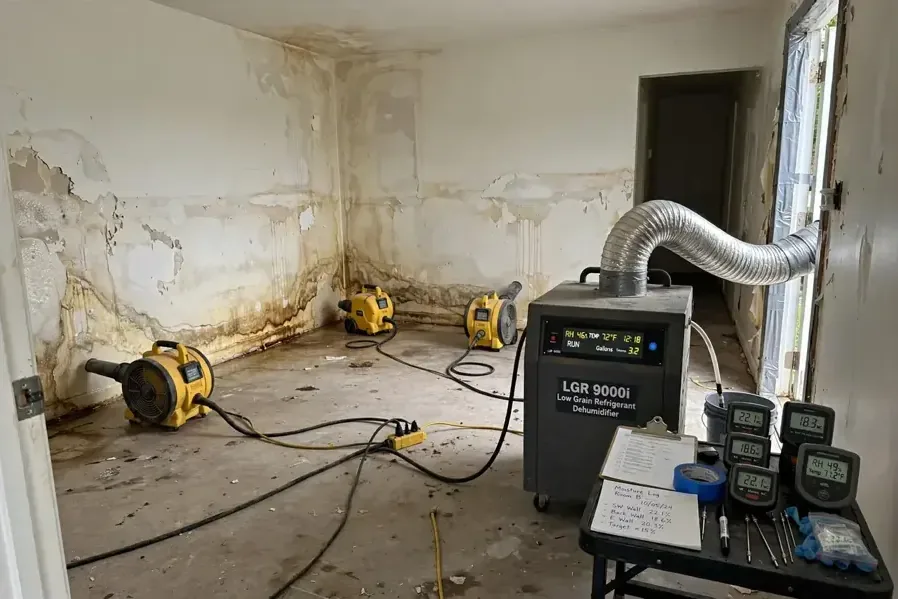
What every structural drying and dehumidification job includes
24/7 dispatch
Active water is treated as urgent at any hour, and the nearest crew rolls with pumps, air movers and meters.
IICRC S500 drying
Truck-mounted extraction, LGR dehumidifiers and air movers, run to a measured dry standard instead of a guess.
Claim-ready records
Moisture maps, daily psychrometric logs and timestamped photos taken before any demolition.
Desert-home experience
Slab floors, attic air handlers, hard water and monsoon runoff shape every drying plan here.
What to do right now for structural drying and dehumidification
- Stop the source. Shut off the water and keep the building closed up.
- Pull standing water. Wet vacs or pumps remove what is on the floor before drying starts.
- Keep rooms closed. Doors and windows stay shut so the dehumidifiers can lower humidity.
- Leave equipment alone. Do not move or switch off air movers, since readings depend on the setup.
What does structural drying and dehumidification cost in South Tucson, AZ?
In South Tucson, AZ, structural drying usually runs $1,500 to $3,500 for one area, while a class 4 loss in slab or hardwood can reach $7,000 to $10,000+ because those materials dry slowly.
Class 1 or 2, one area
- Air movers set
- One dehumidifier
- Daily readings
Class 3, several rooms
- Ceilings and walls dried
- Containment
- LGR dehumidifiers
Class 4, slab or hardwood
- Desiccant units
- Floor drying system
- Extended monitoring
Documentation for the insurance claim
The claim file holds a moisture map, daily psychrometric logs, timestamped photos taken before demolition, the water category and class of loss, and a line-item scope. Sudden and accidental water is often covered, while rising flood water usually needs a separate flood policy. Coverage depends on your policy, so check with your own insurer.
Ranges are typical, not a quote: water category, square footage, material class and how fast drying started move the number most. Run the water damage cost calculator for a closer range.
How structural drying and dehumidification is handled, step by step
Map
Meters and thermal images show the wet areas.
Set equipment
Air movers and dehumidifiers go in.
Monitor
Readings are logged each day.
Finish
Equipment is removed once everything is dry.
Structural drying is what turns a wet building back into a dry one. After the standing water is gone, moisture still sits in framing, subfloors and drywall, and the only way to know it has left is to measure it. The method is the same in any building, from a house to a shop.
How drying is planned
- Class 1 and 2: smaller losses or materials that hold little water
- Class 3: water from above that soaked ceilings, walls and carpet
- Class 4: deeply wet materials such as concrete, hardwood or plaster
Water categories and drying classes decide how many air movers and dehumidifiers go into each room.
After a monsoon downpour
Tucson-area monsoon storms between June 15 and September 30 can leave saturated ground, and after the August 2016 rain a National Weather Service meteorologist warned about exactly that. Water that reaches a building leaves wet drywall, subfloors and framing that dry slowly in closed, humid rooms, so measured drying matters.
What gets logged
Each visit records temperature, humidity and moisture content against dry reference readings, and equipment is moved or removed as materials dry. The log goes to the insurer. Equipment goes in after water extraction, and a sewage backup is cleaned and sanitized before any drying starts.
Structural drying and dehumidification across South Tucson and nearby communities
Structural drying runs across ZIP 85713, in houses, apartment buildings, shops and restaurants alike, from South Fourth Avenue and South Sixth Avenue to the Interstate 10 side of the city.
The same service nearby: structural drying and dehumidification in Marana, Tucson, Oro Valley.
Water damage restoration in South Tucson · every town covered
Related water damage services in South Tucson
Structural Drying and Dehumidification questions, answered
How long does structural drying take?
Usually several days, though concrete and hardwood can take longer. The readings, not the calendar, decide when it ends.
Why are the dehumidifiers so loud?
They move a lot of air and pull moisture from it, so noise and warmth come with the work and stop once the structure is dry.
Can fans alone dry a wet room?
No. Air movers lift moisture off surfaces, and dehumidifiers remove it from the air. Without both, humidity stays high and the damage keeps spreading.
What does a drying class mean?
It describes how much water a material holds and how fast it will dry, from class 1 for small losses to class 4 for dense materials like concrete.
Will the drying raise the power bill?
The equipment draws power while it runs, so the bill goes up for a few days. Keep the bill and ask the insurer how it is treated.
How is dry confirmed?
Meters compare wet materials with dry reference points in the same building, and equipment comes out only when the readings match.
Water left in framing and subfloors keeps causing damage after the surface looks dry
A drying crew can map the moisture, set the right equipment and log readings each day until the building reaches dry.
(888) 949-8496Start the structural drying